California License Plate is a state-issued plate used to identify a registered vehicle and connect it with its vehicle registration record. License plates are required for many registered vehicles and display a unique plate number linked to the vehicle and its registration information. This California plate guide explains how license plates work, how they relate to vehicle registration, getting a plate, and why they are used for vehicle identification. It provides vehicle owners with clear information on different plate types, registration requirements, plate numbers, and common California DMV services. The page also explains the basic role of registration cards and registration decals in keeping vehicle records current.
This provides helpful information about the main types of license plates and the services related to them. Readers can find information about standard plates, personalized plates, specialty plates, commercial plates, motorcycle plates, trailer plates, temporary plates, and other state-issued plate options. The content also covers license plate renewal, replacement, fees, laws, plate display rules, and registration services. Related topics such as vehicle identification, assigned plates, registration documents, and DMV services are explained in clear terms. Whether someone needs general information about a California vehicle license plate or wants to find a specific plate-related service, this resource provides a clear starting point for finding the right information.
How to Apply for a California License Plate
Applying for a license plate depends on the type of plate you are requesting. While standard and personalized plates can often be ordered online, specialty, veteran, and disabled plates require specific supporting documentation and forms.
- Online Services:
- https://www.dmv.ca.gov/portal/dmv-online/
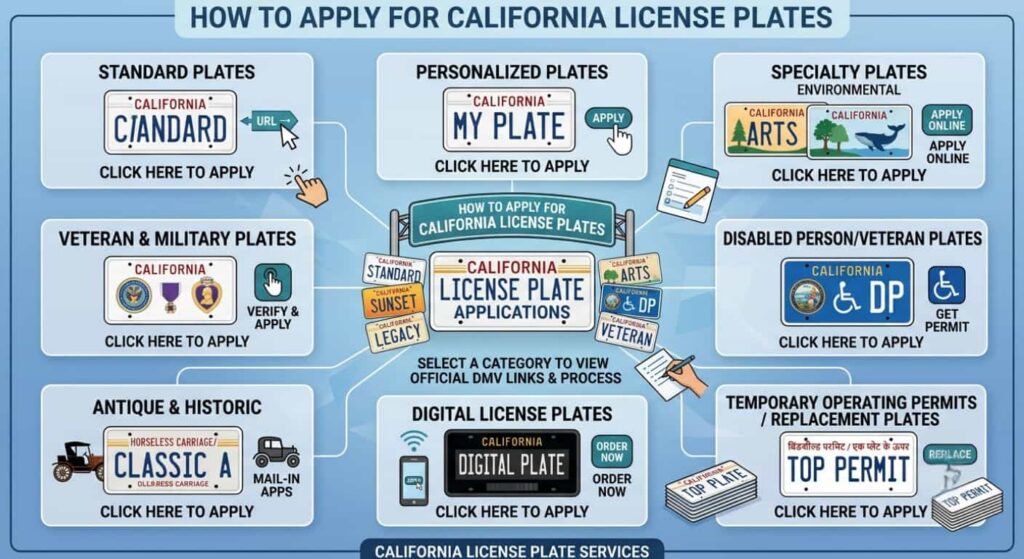
Method: Online, Dealer, or In-Person (DMV / AAA)
Process:- Complete vehicle registration or transfer process.
- Provide Title/Registration, CA insurance, and Smog cert.
- Pay base registration and plate fees.
- Receive plates via mail or at DMV/Dealership.
Method: Online Ordering
Process:- Access CA DMV Plate Configurator online.
- Check availability for 2 to 7 character combinations.
- Ensure text complies with DMV content guidelines.
- Complete Form REG 17 online and pay fee.
- Pick up at chosen DMV office (8–12 weeks).
Method: Online or Mail-In (Form REG 17)
Process:- Browse causes (Tahoe, Arts Council, Kids, etc.).
- Choose sequential or personalized characters.
- Submit online or mail Form REG 17 to Sacramento.
- Pay initial surcharge and annual renewal fees.
Method: Mail-In or In-Person
Process:- Select military branch/medal category.
- Obtain DD-214 service certification from CVSO.
- Fill out Form REG 17A.
- Submit verified form and fees to DMV.
Method: Mail-In or In-Person Only
Process:- DP: Have medical doctor sign Form REG 195.
- DV: Obtain USDVA letter & Form REG 256A.
- Submit application in person or by mail.
- No issuance fee (DV exempt from reg fees).
Method: Mail-In Application
Process:- Confirm eligibility (35+ yrs or pre-1922).
- Complete Form REG 17A with vehicle proof.
- Mail form and fees to Sacramento Special Processing.
Method: Approved Vendor (Reviver)
Process:- Order hardware via provider (e.g., Reviver).
- Select monthly or annual subscription plan.
- Link CA vehicle registration details.
- Install hardware and activate via mobile app.
Method: In-Person (DMV / Service)
Process:- Ensure registration fees are already paid.
- Provide proof why permanent plates are delayed.
- Complete Form REG 256 (Statement of Facts).
- Pay TOP fee ($50 for smog failure permit).
Method: Online, Mail-In, or In-Person
Process:- Complete Form REG 156 (Replacement Application).
- File local police report if plates were stolen.
- Surrender remaining physical plates to DMV.
- Pay $27.00 standard replacement fee.
How License Plates Work With Vehicle Registration
A California vehicle license plate identifies a registered vehicle, while its registration record confirms that the vehicle is legally registered with the state. The California DMV license plate and vehicle registration work together, with the plate number, registration card, and registration decal linking the vehicle to its official record.
License Plate vs. Vehicle Registration
A license plate is the physical plate attached to a vehicle for identification. The plate number is the unique combination of letters and numbers shown on that plate. It helps connect the vehicle to its state registration record. Vehicle registration is the official record that shows a vehicle has been registered with the California Department of Motor Vehicles (DMV). The registration record contains information linked to the vehicle and its registered owner. A registration card provides proof of registration and may need to be kept in the vehicle.
The main difference can be seen below:
| Item | Purpose |
|---|---|
| License Plate | Identifies the registered vehicle on public roads. |
| Plate Number | Identifies the specific license plate assigned to the vehicle. |
| Registration Card | Provides proof of the vehicle’s current registration. |
| Registration Decal | Shows the vehicle’s current registration validity on the license plate. |
| Vehicle Registration | Creates the official state record for the registered vehicle. |
For a California vehicle owner, these items work as connected parts of the same registration system. A plate does not replace the registration record, and a registration card does not replace the physical plate.
Registration Stickers and Decals
A registration decal, often called a registration sticker, is placed on the rear license plate of a registered vehicle. It shows the registration expiration information and indicates that the vehicle has a current registration. After a registration renewal is processed, the DMV issues a new registration card and a new sticker or tabs for the vehicle. The sticker or tabs display the updated expiration information.
A California vehicle owner can check the current registration status through the official DMV website. The official online service can be used to renew vehicle registration, check registration status, and manage related DMV services.
- Official California DMV services:
- https://www.dmv.ca.gov/
For detailed information about renewal requirements, deadlines, and the renewal process, the dedicated Registration Renewal page provides more information.
How Plate and Registration Information Connect
A License Plate and vehicle registration record are linked to the same registered vehicle. The connection works through several key details:
- California DMV — License Plates, Decals and Placards:
- https://www.dmv.ca.gov/portal/vehicle-registration/license-plates-decals-and-placards/
Assigned Plate
The DMV assigns a license plate to a registered vehicle and records its plate number.
Vehicle Owner
The registration record contains information about the registered vehicle owner.
Registration Record
The plate number connects with the vehicle’s official registration record maintained by the California DMV.
Vehicle Identification
Details such as the VIN help identify the specific vehicle connected to the license plate.
Registration Card
The registration card provides proof that the vehicle has a current registration record.
DMV Services
Plate replacement, registration renewal, and other vehicle services are processed using existing registration information.
California License Plate Types at a Glance
California license plates vary by vehicle classification, registration category, and intended use. The California Department of Motor Vehicles (DMV) issues distinct plate types for passenger vehicles, commercial trucks, motorcycles, trailers, personalized requests, specialty causes, and military service recognition. Each plate type carries its own eligibility criteria, fee structure, and application procedure. Understanding these categories ensures vehicle owners select the correct plate type and comply with all state registration requirements.
California Plate Categories:
| Plate Category | Vehicle / Applicant Eligibility | Key Features & Requirements |
|---|---|---|
| Standard Passenger | Cars, SUVs, and passenger vans | Standard sequential lettering issued with regular vehicle registration. |
| Commercial | Delivery trucks, commercial vans, and pickup trucks | Subject to commercial registration classifications and weight-based fees. |
| Motorcycle | Motorcycles and motor-driven cycles | Smaller plate size with a unique character format. |
| Permanent Trailer (PTI) | Utility, cargo, and farm trailers | Issued under the Permanent Trailer Identification (PTI) program with maintenance fees due every five years. |
| Specialty / Cause | Any registered vehicle owner | Supports approved state programs such as Whale Tail, Arts Council, and Lake Tahoe. |
| Personalized (Vanity) | Any eligible registered vehicle | Custom plate message of up to seven characters, subject to DMV approval. |
| Veteran & Military | Eligible veterans and active-duty service members | Requires proof of military service through CalVet or qualifying discharge documents (DD-214). |
Personalized and Vanity Plates
Personalized license plates allow vehicle owners to request a custom character configuration (up to 7 characters for standard vehicles, or up to 5 characters for motorcycles) instead of a standard sequential number.
- DMV Review & Prohibitions: All requested configurations undergo a manual review by the DMV. Configurations that contain offensive language, hate speech, vulgarity, or references to law enforcement codes (e.g., “911” or “PD”) are automatically rejected.
- Special Characters: Select specialty plates allow specific graphic symbols (such as a heart, hand, star, or plus sign).
Specialty and Special Interest Plates
Specialty plate programs allow drivers to show support for specific state organizations, environmental causes, or public interest programs.
- Funding Impact: Revenue generated from initial application fees and annual renewal surcharges directly funds state programs, such as environmental conservation, public arts, and emergency worker memorials.
- Available Formats: Most specialty designs can be ordered with either standard sequential numbering or customized personalized text.
Veteran and Military Plates
California honors military service through specialized license plates issued to eligible active-duty members, honorably discharged veterans, and service award recipients.
- Eligibility Verification: Applicants must provide official proof of military service (such as Form DD-214 or a certified statement of service) through the California Department of Veterans Affairs (CalVet) before submitting the DMV application.
- Special Recognition: Specific plates exist for Congressional Medal of Honor recipients, Former Prisoners of War (POW), Pearl Harbor Survivors, and Purple Heart recipients—many of which qualify for fee waivers.
Official California DMV Resources
For official application forms, eligibility guidelines, fee schedules, and online plate ordering services, visit the official state portals:
- CalVet Veteran License Plate Verification:
- https://www.calvet.ca.gov/VetServices/Pages/License-Plates.aspx
- California DMV License Plates & Decals:
- https://www.dmv.ca.gov/portal/vehicle-registration/license-plates-decals-and-placards/
Standard California License Plates
California standard license plates are the regular plates issued for registered vehicles and help confirm registration while identifying the vehicle and its registration type. A standard California car license plate is commonly issued for passenger vehicles, while other standard plate formats serve commercial vehicles, motorcycles, and certain trailers.
What Are California Standard License Plates?
Standard license plates are the regular state-issued plates used to identify registered vehicles in California. They show a unique plate number connected with the vehicle’s DMV registration record and help identify the type of registration assigned to that vehicle.
The California DMV states that standard plates can be associated with several vehicle categories, including:
- California DMV Vehicle Registration Status service
- https://www.dmv.ca.gov/portal/vehicle-registration/vehicle-registration-status/
- Passenger vehicles
- Commercial motor vehicles
- Motorcycles
- Permanent trailers
- Trailer coaches
- Park trailers
The exact plate type depends on the vehicle’s classification and registration. As a result, a standard plate for a passenger vehicle may differ from the plate issued for a motorcycle or commercial vehicle.
When Are Standard Plates Issued?
The California DMV states that standard license plates may be issued when a person:
- Buys a new vehicle that requires California registration.
- Replaces lost, stolen, or damaged plates when standard replacement plates are appropriate.
- Surrenders special-interest plates and receives standard plates instead.
Standard plates generally remain with the vehicle to which they were issued. Special rules can apply to certain personalized, environmental, special-recognition, or special-interest plates.
Numbers and Identification
A California plate number identifies a registered vehicle and connects the plate to a vehicle registration record. A California vehicle license plate is different from a VIN or registration number, and each serves a separate purpose in vehicle identification and registration.
What Is a Plate Number?
A plate number is the unique combination of letters and numbers displayed on a California vehicle license plate. The California Department of Motor Vehicles (DMV) assigns the plate to a vehicle as part of the registration process. The plate number helps law enforcement, government agencies, and authorized parties identify the vehicle linked to a registration record. The plate itself is displayed on the vehicle, while the associated registration record contains information about the registered vehicle owner and the vehicle. A plate number can appear on registration documents and DMV records.
For most vehicles, the plate number is visible from outside the vehicle. It may be used when completing certain DMV services, reporting a lost or stolen plate, or referring to a vehicle during a traffic or registration matter.
How Plate Numbers Identify Vehicles
A California plate number acts as a visible identifier for a registered vehicle. It connects the physical plate displayed on the vehicle with the vehicle’s registration record maintained by the California DMV. The plate number can help identify the vehicle associated with a specific registration record. Still, it does not provide the public with unrestricted personal information about the vehicle owner. California DMV records contain protected personal information, and availability depends on applicable privacy rules and authorized purposes.
A plate number may be needed for several vehicle-related tasks, such as:
- Checking certain vehicle registration details through official DMV services
- Completing registration or renewal transactions
- Reporting a lost, stolen, or damaged license plate
- Referring to a vehicle during a traffic or insurance matter
- Identifying the correct vehicle on DMV paperwork
- Managing certain plate or registration services
For official California DMV services, the plate number may be requested along with other details. Users can visit the California DMV official website and select the relevant vehicle registration service.
Plate Number vs. VIN
A plate number and a VIN both help identify a vehicle, but they are different identifiers. A plate number is displayed on the license plate and can change if a vehicle receives a replacement or different plate. A VIN is a permanent vehicle identifier assigned by the manufacturer and remains associated with that specific vehicle.
| Identifier | What It Means | Main Use |
|---|---|---|
| Plate Number | Letters and numbers displayed on the license plate | Identifies the registered vehicle for law enforcement, registration, and public identification. |
| VIN | A unique 17-character Vehicle Identification Number | Identifies the specific vehicle throughout its manufacturing, ownership, and registration history. |
| Registration Number | A number or identifier linked to a vehicle’s registration record | Used to locate and manage registration transactions and official DMV records. |
| Vehicle Identification | A broad term covering identifiers used to distinguish a vehicle | Supports vehicle registration, title, insurance, and other legal records. |
Colors and Designs
License Plates come in different colors, designs, and lettering styles based on the plate type and its purpose. The standard plate has a white background with blue lettering, while specialty, legacy, black, and personalized plates can have different visual styles and configurations.
Standard License Plate Appearance
The standard license plate is commonly recognized by its white background, blue lettering, and red “California” script across the top. This state-issued plate identifies a registered vehicle and connects the visible plate number with the vehicle’s registration record.
| Plate Type | Main Color / Background | Lettering or Design | Main Purpose |
|---|---|---|---|
| Standard California Plate | White | Blue characters with red “California” script | Regular vehicle registration |
| Legacy Plate | Black or other historical-style colors, depending on the selected design | Historical California lettering style | Provides a vintage appearance while remaining DMV-approved |
| Specialty Plate | Varies by program | Custom graphics, logos, or themed artwork | Supports approved causes, organizations, or special interests |
| Personalized Plate | Based on the selected plate type | User-selected approved letters and numbers | Displays a personalized identification or custom message |
| Veteran / Military Plate | Varies by military plate program | Military emblems, service-related graphics, or special wording | Recognizes military service and veteran status |
| Disabled Person Plate | Official DMV-issued design | Plate number with disability-related designation | Provides eligible disabled parking privileges |
| Commercial Plate | Standard or applicable commercial design | Plate number identifying the registered vehicle | Registers and identifies commercial vehicles |
| Motorcycle Plate | Smaller plate format | California motorcycle lettering and number configuration | Motorcycle registration and identification |
| Trailer Plate | Design based on trailer classification | Assigned registration number | Trailer registration and identification |
California Plate Colors and Lettering Styles
California plate colors can help distinguish different plate designs and special programs, but color alone does not determine a vehicle’s registration status. The plate number, registration record, and registration decal provide the main identification and registration information.
The main visual elements can include:
- Background color: The base color behind the plate number.
- Lettering color: The color used for the assigned plate number and characters.
- California script: The familiar red script at the top of the standard plate.
- Graphics: Images or logos used on specialty and special-interest plates.
- Plate number: The assigned or personalized combination of letters and numbers.
Specialty and Personalized Plate Designs
California offers specialty license plates with graphics linked to causes, organizations, or special recognition. Some designs support programs related to arts, agriculture, environmental interests, museums, awareness campaigns, and other causes. Special plates can recognize service, achievements, status, historical significance, or occupations. Personalized plates allow an approved combination of letters and numbers. The selected configuration must meet California DMV requirements, and certain combinations can be rejected if they are considered offensive, misleading, or confusingly similar to another plate.
Legacy and Black License Plate Designs
California’s 1960s Legacy License Plates use a historical-style appearance based on earlier California plate designs. These plates can be ordered in sequential or personalized configurations under current DMV requirements. Black plate designs are associated with California’s historic plate styles and are popular among vehicle owners seeking a classic appearance. More information about available black designs and related requirements is available on the Black License Plates page.
Specialty and Special License Plates
California specialty license plates give vehicle owners options beyond standard plates, while special plates can recognize military service, achievements, status, historical significance, or certain occupations. Special interest plates can support approved causes and organizations, making them different from regular registration plates.
Specialty Plates vs. Standard Plates
Standard plates provide the basic state-issued plate used to identify a registered vehicle. Specialty plates offer a different design or purpose and may support a cause, organization, or special recognition program.
California plate categories can include:
- Standard plates for regular vehicle registration
- Special interest plates linked to approved causes or organizations
- Legacy plates that use selected historic California plate designs
- Veteran and military plates that recognize military service
- Special plates connected with certain achievements, status, historical significance, or occupations
Special interest plates can support causes through additional fees tied to eligible programs. The exact eligibility, application process, fees, and available designs depend on the plate type.
Availability, Approval, and Costs
Before applying, the requested character combination can be checked through the official California DMV personalized plate ordering system. The DMV reviews requested configurations, and some combinations may be unavailable or rejected under its rules. The cost depends on the plate type and whether the configuration is sequential or personalized. Some current special-interest plate examples show the following fees:
| Plate Type | Sequential | Personalized |
|---|---|---|
| Many Special Interest Plates | $50 | $103 |
| California 1960s Legacy | $50 | $50 |
| Environmental | — | $53 |
| Veterans’ Organizations | $50 | $78 |
| Have A Heart, Be A Star, Help Our KIDS | $20 | $50 |
Sequential: $50
Personalized: $103
Sequential: $50
Personalized: $50
Sequential: —
Personalized: $53
Sequential: $50
Personalized: $78
Sequential: $20
Personalized: $50
Different Vehicle Types
California vehicle license plates are issued according to a vehicle’s classification and registration type. While passenger vehicles, motorcycles, commercial vehicles, and trailers all require valid registration, each category follows its own California DMV requirements for plate issuance, registration, and use.
Commercial Vehicle Plates
Commercial vehicle plates are issued to vehicles registered for business or commercial purposes. Registration requirements vary depending on the vehicle’s classification, weight, and intended use. Commercial registration may apply to delivery vehicles, fleet vehicles, business-owned vehicles, and trucks used to transport goods or equipment.
Examples of commercial vehicles include:
- Commercial trucks
- Business-use vehicles
- Fleet vehicles
- Vehicles used to transport goods
- Official California DMV Motor Carrier Services:
- https://www.dmv.ca.gov/portal/vehicle-industry-services/motor-carrier-services-mcs
Vehicle owners can review commercial registration requirements, operating information, and related services through the California DMV Motor Carrier Services portal.
Trailer Plates
Trailers have their own registration classifications and license plate requirements based on their type and intended use. Utility trailers, cargo trailers, permanent trailers, trailer coaches, and other trailer categories may follow different California DMV registration rules.
| Trailer Type | Registration Focus |
|---|---|
| Utility and Cargo Trailers | Trailer registration and assigned plate |
| Permanent Trailers (PTI) | Permanent Trailer Identification (PTI) registration |
| Trailer Coaches | Registration based on trailer classification |
Registration fees and requirements vary depending on the trailer type and registration program. Vehicle owners should review the applicable California DMV requirements before registering or renewing a trailer.
Registration and Renewal
License Plate registration connects a vehicle to its official DMV record and confirms that the vehicle can legally operate on public roads. A vehicle owner must keep the registration current and renew it before the listed expiration date to maintain valid registration status.
How California Vehicle Registration Works
A California vehicle registration record links a vehicle with its registered owner and identifies the vehicle through its plate number and other official details. The registration process creates a record with the California Department of Motor Vehicles (DMV), while the physical license plate provides a visible identifier for the registered vehicle.
The registration record may include important information such as:
- Vehicle owner’s name and address
- License plate number
- Vehicle identification number (VIN)
- Registration expiration date
- Registration classification
- Registration card details
A valid registration status means the vehicle has current registration with the DMV. The registration card serves as proof of registration and should be kept with the vehicle or in another secure place where it can be presented when required.
Registration Renewal and Expiration Dates
California vehicle registration is renewed regularly, with most vehicle registrations requiring renewal every year. The registration expiration date appears on the registration card and registration sticker, helping the vehicle owner track when the current registration period ends. A renewal notice may be sent before the expiration date and can provide information about the renewal period, fees, and available renewal options. The vehicle owner should review the notice and current registration details for accuracy. An expired registration can result in penalties and may affect the vehicle’s legal operation on public roads, so keeping the registration current helps prevent avoidable issues linked to late renewal.
Getting, Changing, or Replacing a Plate
A California vehicle owner can get a license plate through the vehicle registration process, replace a plate that is lost, stolen, damaged, or unreadable, or handle certain plate changes through the California DMV. The correct application, supporting documents, remaining plate, and applicable fee depend on the type of plate and the requested transaction.
Replacing a Lost or Damaged Plate
A license plate is issued as part of California vehicle registration and links the registered vehicle with its assigned plate number. A vehicle owner may receive standard plates or apply for certain personalized, specialty, or special recognition plates based on the vehicle and eligibility requirements. For official plate services, the California DMV provides online services and office-based transactions. The DMV’s online portal lets users select services such as vehicle registration, special interest or personalized plates, and other plate-related transactions.
For users who need to find the correct official service, the basic search process is:
- The official California DMV website.
- https://www.dmv.ca.gov/portal/locations/
- Select Vehicle Registration or License Plates, Decals & Placards.
- Choose the service that matches the need, such as ordering personalized plates or replacing plates.
- Follow the listed application and payment requirements.
- Use a DMV office when the transaction requires in-person service.
The official DMV locations page can help users find a nearby office and available plate services. It lists options for ordering special or personalized plates, plate reassignment, and replacing lost, stolen, or damaged plates.
Replacing a Lost or Damaged Plate
A license plate should be replaced when it is lost, stolen, damaged, or illegible. California DMV states that replacement plates and registration stickers should be obtained immediately when they are lost, stolen, damaged, or cannot be read clearly.
The replacement process can vary by plate type. A request may require:
- California DMV Replacement License Plates and Stickers:
- https://qr.dmv.ca.gov/portal/vehicle-registration/license-plates-decals-and-placards/replacement-license-plates-and-stickers/
- A completed replacement application
- Valid identification
- Any remaining license plate
- Applicable replacement fees
- A police report when plates were stolen
For standard plates, the DMV provides an online replacement option. Other plate types may require a specific form or an in-person or mail submission. The official DMV replacement page lists the current requirements and available methods.
Changing or Transferring Plate Information
A plate change can involve a new vehicle, a change in ownership, a personalized plate, or reassignment of a plate to another vehicle. The process depends on the plate type and the relationship between the registered owner, vehicle owner, and plate owner. For personalized or special-interest plates, California DMV allows certain plates to be reassigned, retained for future use, converted, or transferred under specific conditions. The DMV states that a personalized or special-interest plate owner may need to complete the appropriate REG 17 application when reassigning or retaining the plate.
- California DMV Online Services:
- https://www.dmv.ca.gov/portal/dmv-online/
A vehicle owner looking for an official plate or vehicle record service can use the California DMV’s online search and service options. The DMV online portal includes options for ordering vehicle records and special interest or personalized plates.
Fees and Costs
License Plate fees vary based on the plate type, vehicle registration status, and service requested. Standard plates, personalized plates, specialty plates, replacements, and registration services can each have different charges. The total amount can change based on the vehicle and transaction. A vehicle owner may pay a plate fee, application charge, registration fee, renewal amount, or replacement cost, depending on the service.
What Affects Plate Fees?
The California Department of Motor Vehicles (DMV) handles license plate issuance and vehicle registration. As a result, the final amount often depends on the type of plate and the transaction being completed.
Cost factors and official estimated fees include:
| Service / Plate Type | Description & What Affects Cost | Official CA DMV Fee (Approx. / Standard) |
|---|---|---|
| Base Vehicle Registration | Base registration fee + CHP and state fees (excludes VLF/TIF based on vehicle value) | ~$71.00 base ($100+ total base fees) |
| Standard Replacement Plates | Replacement fee for lost, stolen, or damaged regular plates (Auto, Commercial, Motorcycle) | $27.00 |
| Environmental (Personalized) Plates | Standard California plate with customized text/numbers (no special graphic) | $53.00 initial / ~$43.00 annual renewal |
| Specialty Plates (Sequential) | Plates with custom designs (Arts, Snoopy, Tahoe, Legacy, Kids, etc.) with auto-assigned numbers | $50.00 initial / $40.00 annual renewal |
| Specialty Plates (Personalized) | Custom design plates with user-chosen text/numbers | $103.00 initial / $83.00 annual renewal |
| Specialty Plate Replacement | Replacement for lost/damaged specialty plates | $20.00 – $35.00 (varies by plate type) |
| Registration Renewal / Services | Vehicle License Fee (VLF = 0.65% value) + Transportation Improvement Fee (TIF) + Transfer fees | Varies by vehicle value & type |
Base fee + CHP & state fees.
Fee: ~$71.00 base ($100+ total)
Replacement for lost/damaged regular plates.
Fee: $27.00
Custom text on standard plate.
Fee: $53.00 initial / ~$43.00 renewal
Custom design with auto-assigned numbers.
Fee: $50.00 initial / $40.00 renewal
Custom design with chosen text.
Fee: $103.00 initial / $83.00 renewal
Replacement for specialty plates.
Fee: $20.00 – $35.00
VLF + TIF + Transfer fees.
Fee: Varies by vehicle value & type
Note on Credit/Debit Card Payments: The California DMV adds a processing fee of approximately 1.95% to 2.3% on all card transactions.
How to Check the Current License Plate Cost
Since DMV fees can change or vary depending on your specific vehicle’s assessed value, the most reliable source is the official California DMV website. The vehicle owner can search the DMV site for “license plate fees” or use the official DMV Fee Calculator to get an exact breakdown.
- Official California DMV Portal: California DMV License Plates, Decals & Placards
- Official DMV Fee Calculator: California DMV Vehicle Registration Fee Calculator
- https://www.dmv.ca.gov/portal/vehicle-registration/registration-fees/vehicle-registration-fee-calculator/
A vehicle owner should check the current DMV fee information before submitting an application or payment to confirm the exact final total for their selected plate or registration service.
Digital and Temporary Plates
Digital license plates use an electronic display to show vehicle registration information, while temporary license plates or permits help a vehicle operate legally during a pending registration process. The California DMV provides separate services and information for electronic plates, temporary operating permits, and vehicles waiting for permanent registration documents.
Digital License Plates
Digital license plates use an electronic HD display instead of a traditional printed metal plate. In California, digital plates are authorized by the state under AB-984 and supplied exclusively through DMV-approved providers (such as Reviver / RPLATE).
Features & Benefits
- In-App Registration Renewal: Renew your DMV tags directly through the smartphone application without applying physical stickers.
- Visual Personalization: Toggle between light and dark display modes or add customized banner messages.
- Security & Anti-Theft: Displays a clear “DETACHED” alert on the screen if stolen or tampered with.
Estimated Digital Plate Costs & Fees
Digital license plate costs consist of the hardware purchase price (or lease) plus a recurring service subscription, in addition to standard California DMV vehicle registration fees.
| Digital Plate Component | Description / Service | Estimated Cost (USD) |
|---|---|---|
| RPLATE Hardware Purchase | Battery-powered or hardwired digital plate unit | $499.00 – $599.00 (one-time) |
| Annual Service Plan | Basic/Standard digital updates & registration renewal feature | ~$35.00 – $45.00 / year |
| Premium Subscription | Unlimited messaging, advanced security alerts & GPS features | ~$125.00 / year (or ~$39.95 / month) |
| Standard DMV Registration | State registration, CHP, and county fees (paid separately to DMV) | Varies by vehicle |
Battery-powered or hardwired unit.
Cost: $499.00 – $599.00 (one-time)
Basic digital updates & renewal feature.
Cost: ~$35.00 – $45.00 / year
Unlimited messaging, security & GPS.
Cost: ~$125.00 / yr (or ~$39.95/mo)
State, CHP, and county fees.
Cost: Varies by vehicle
Temporary License Plates & Operating Permits (TOP)
Temporary license plates or permits help a vehicle operate legally when permanent registration documents or physical plates are pending issuance. A Temporary Operating Permit (TOP) or temporary paper plate is placed on the vehicle’s windshield or rear area.
Common Temporary Permit Types & Cost Table:
| Permit / Transaction Type | Situation & Purpose | DMV Fee | Duration |
|---|---|---|---|
| 60-Day TOP (Smog Failure) | Issued when registration fees are fully paid but the vehicle failed biennial smog certification | $50.00 | 60 Days |
| 30-Day TOP (Incomplete App) | Issued for out-of-state vehicles or pending clearance/impound scenarios | Free (Included with registration) | 30 Days |
| One Trip Permit (REG 402) | For moving an unregistered vehicle for repairs, inspections, or moving state-to-state | $28.00 | Single Trip / Single Day |
| New Purchase / Dealer Tag | Temporary paper license plates assigned immediately at dealership sale | Covered in transfer fees | Up to 90 Days |
Issued when fees are paid but smog failed.
Fee: $50.00
Duration: 60 Days
For out-of-state or pending clearance.
Fee: Free (With registration)
Duration: 30 Days
Moving unregistered vehicle for repairs/moving.
Fee: $28.00
Duration: Single Trip / Day
Temporary paper plates at dealership sale.
Fee: Covered in transfer fees
Duration: Up to 90 Days
Black, Historic, Veteran, and Disabled License Plates
California offers several specialized plate programs catering to classic vehicle enthusiasts, military veterans, and motorists requiring specific accessibility privileges. Each plate type has unique eligibility criteria, fees, and application procedures managed by the California Department of Motor Vehicles (DMV).
Black (Legacy) License Plates
California’s 1960s Legacy License Plate program allows drivers of any year or model vehicle to order classic black-and-yellow plates.
- Purpose: Provides a retro aesthetic for modern and classic vehicles while functioning as fully legal state registration.
- Requirements: Available to any registered vehicle owner (can be ordered with standard sequential numbers or personalized text).
- DMV Form required: Form REG 17.
Historic & Antique License Plates
Historic plates are restricted to vehicles with collector significance and specific historical age thresholds:
- Horseless Carriage Plates: For vehicles manufactured before 1922 or with 16 or more cylinders.
- Historical Vehicle Plates: For vehicles manufactured after 1922 that are at least 35 years old and maintained primarily as collector items, parade vehicles, or historic exhibits (not for daily commute).
Veteran License Plates
California honors active duty military members, honorable veterans, and decorated service personnel with several special military plates:
- Honoring Veterans Plates: Features specific military branch seals or service logos.
- Decorated Veterans Plates: Special recognition for Medal of Honor, Purple Heart, Ex-POW, or Pearl Harbor Survivors.
- Requirements: Proof of military service (DD-214 or discharge papers) certified by a County Veteran Service Officer (CVSO).
Disabled Person (DP) & Disabled Veteran (DV) Plates
These plates grant specific parking privileges in designated blue zones, metered spaces without charge, and specified commercial loading zones.
- Disabled Person (DP) Plates: Available to qualifying individuals with permanent mobility limitations. Requires a medical provider’s certification via Form REG 195.
- Disabled Veteran (DV) Plates: Available to qualified veterans whose disability is 100% service-connected. Exempts the owner from most registration and license fees.
Comparison & Price Breakdown
| Plate Category | Key Purpose | Primary Eligibility Requirement | Official DMV Fee (Approx.) | DMV Form Needed |
|---|---|---|---|---|
| Black / Legacy Plates | Retro 1960s design for any vehicle | Open to all registered CA vehicles | $50 initial / $40 annual renewal | Form REG 17 |
| Historical Vehicle Plates | Collector & parade vehicle recognition | Vehicle must be 35+ years old (or pre-1922 for Horseless Carriage) | ~$15 – $50 initial (Restrictions apply) | Form REG 17A |
| Veteran License Plates | Military service honor & recognition | Proof of military service (DD-214 / CVSO verification) | $50 initial / $40 annual renewal | Form REG 17A + CVSO |
| Disabled Person (DP) Plates | Parking accessibility privileges | Certified permanent physical disability (Medical Doctor sign-off) | NO FEE (Standard registration applies) | Form REG 195 |
| Disabled Veteran (DV) Plates | Accessibility + Complete registration fee exemption | 100% service-connected disability certified by USDVA | NO FEE (Full Fee Exemption) | Form REG 256A |
Purpose: Retro 1960s design
Eligibility: Open to all CA vehicles
Fee: $50 initial / $40 renewal
Form: Form REG 17
Purpose: Collector & parade recognition
Eligibility: 35+ years old (or pre-1922)
Fee: ~$15 – $50 initial
Form: Form REG 17A
Purpose: Military service recognition
Eligibility: DD-214 / CVSO verification
Fee: $50 initial / $40 renewal
Form: Form REG 17A + CVSO
Purpose: Parking accessibility
Eligibility: Doctor-certified disability
Fee: NO FEE (Std. reg. applies)
Form: Form REG 195
Purpose: Accessibility & fee exemption
Eligibility: 100% USDVA disability
Fee: NO FEE (Full Exemption)
Form: Form REG 256A
Frequently Asked Questions
California license plates identify registered vehicles and connect each vehicle with its state registration record. The California Department of Motor Vehicles (DMV) provides official services for registration, plate replacement, personalized plates, temporary permits, and other plate-related needs.
What is a California license plate?
A license plate is a state-issued identification plate attached to a registered vehicle. It displays a unique plate number that helps identify the vehicle for registration and enforcement purposes. The plate works with the vehicle registration record maintained by the California DMV. Plates can vary by vehicle type, registration category, and selected specialty or personalized options. For official plate information, the California DMV license plate page is the primary source for current requirements and services.
What does a license plate identify?
A License Plate identifies a vehicle through its assigned plate number and connects it with the state’s registration records. Law enforcement and authorized agencies can use the plate number as part of vehicle identification and registration checks. A plate does not publicly display the vehicle owner’s private information. The plate number, VIN, registration card, and vehicle title serve different purposes within the vehicle record system.
What is the difference between a license plate and registration?
A license plate is the physical identification plate displayed on a vehicle, while vehicle registration confirms that the vehicle is registered with the California DMV. Registration includes records such as the vehicle owner’s information, vehicle details, registration status, and expiration date. A registration card provides proof of registration, while a registration decal or sticker shows the current registration period. The following table explains the main difference:
| Item | Main Purpose |
|---|---|
| License Plate | Identifies the registered vehicle through a plate number |
| Registration | Records the vehicle’s legal registration with the DMV |
| Registration Card | Provides proof of current vehicle registration |
| Registration Decal | Shows the vehicle’s current registration period |
| VIN | Provides a unique identification number assigned to the vehicle |
What is the registration decal on a California plate?
A registration decal is a sticker placed on the license plate to show the vehicle’s current registration status. It displays registration information that helps indicate whether the registration period is current. After a successful registration renewal, the DMV issues the applicable registration card and sticker. A vehicle owner can check the official California DMV website for current renewal services and registration requirements.
What types of license plates are available in California?
California offers several plate categories based on vehicle use, owner eligibility, and personal preferences. Standard plates serve common vehicle registration needs, while other options support special interests, military recognition, personalized messages, or specific vehicle categories.
Types include:
- Standard license plates
- Personalized and vanity plates
- Specialty and special interest plates
- Veteran and military plates
- Commercial vehicle plates
- Motorcycle plates
- Trailer plates
- Disabled person plates
- Digital license plates
- Temporary plates and permits
- Historic and other special plate options
Each category can have different eligibility rules, fees, and application requirements.
Do California vehicles need front and rear plates?
California generally requires vehicles to have two license plates, one plate on the front and one on the rear. The California Vehicle Code sets the rules for plate display, and some vehicle types or situations may have different requirements. A vehicle owner should check the current California DMV requirements and applicable state law before removing or relocating a plate. The official DMV license plate resources provide current information about plate display requirements.